
Assistance & Therapy Dog Training Adelaide
Individualised, reward-based training for assistance dogs and personal therapy dogs, supporting children, teenagers and adults.
At Paws & Reward, we provide professional assistance dog and personal therapy dog training across Adelaide, the Adelaide Hills and Southern Suburbs.
Our programs support individuals and families with a range of needs, including autism, ADHD, PTSD and other disabilities or additional support needs. We're working towards becoming an authorised Public Access Test provider, with approval anticipated in early 2027.
Whether you're considering an assistance dog, looking for a therapy dog to support your child or family at home, or already have a dog you'd like to train for a specific role, we can help you explore the most appropriate pathway.
Our approach focuses on developing confident, emotionally resilient dogs with practical skills suited to their intended roles. We prioritise animal welfare, individual suitability and positive reinforcement throughout every stage of training.
Important Program Information
-
Although assistance dogs and therapy dogs can both provide valuable support, their roles and legal recognition are different.
Assistance Dogs
Assistance dogs are specifically trained to perform tasks that alleviate the effects of a person's disability.They may assist with everyday activities, respond to disability-related needs and accompany their handler in public environments where pets are not normally permitted, provided they meet the relevant legal requirements.
At Paws & Reward, our assistance dog training pathway is currently designed for individuals aged 16 and over.
Personal Therapy Dogs
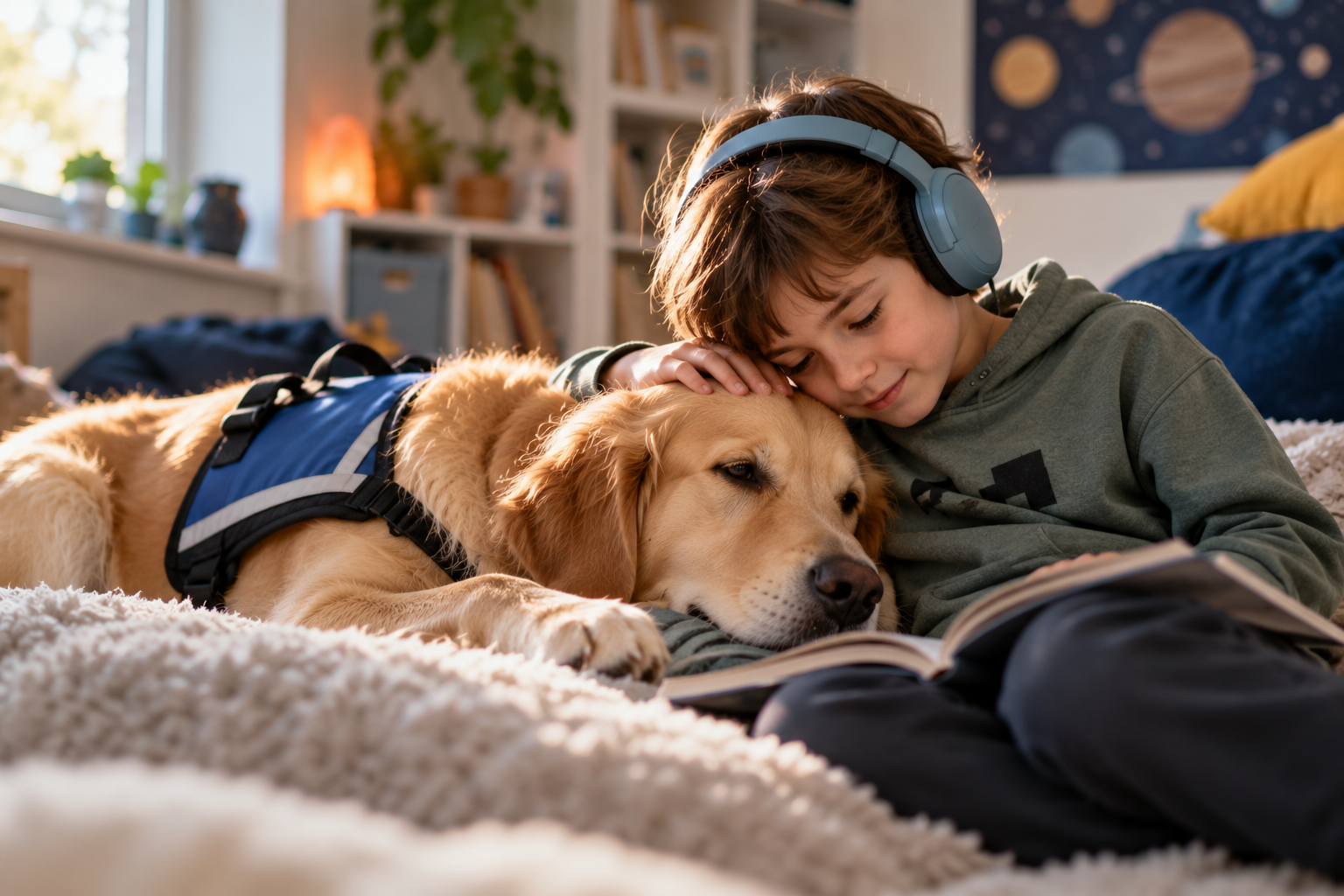
Personal therapy dogs provide companionship, emotional support and a calming presence for individuals and families, particularly children and teenagers with additional needs.Unlike traditional visiting therapy dogs, which may work in schools, hospitals or aged care facilities, our Personal Therapy Dog Training program focuses on supporting individuals within their own family and home environment.
Training may include settling calmly alongside a child, responding to cues from caregivers, developing positive interactions and supporting predictable daily routines.
Personal therapy dogs are not legally recognised assistance dogs simply because they have completed training and do not have automatic public access rights.
-
Our programs are particularly focused on supporting individuals and families navigating:
Autism
ADHD
PTSD and other psychiatric conditions
Other disabilities or additional support needs where a suitably trained dog may provide practical or emotional support
Assistance Dog Training: Currently available for eligible individuals aged 16 and over.
Personal Therapy Dog Training: Available for children, teenagers and adults, with active parent or caregiver involvement where appropriate.
If you're unsure which pathway would be most appropriate, please contact us to discuss your circumstances.
-
Training a dog for a specialised support role requires careful planning, realistic expectations and an ongoing commitment.
It's important to understand that:
Training requires consistent practice between sessions.
There is a financial and time commitment involved.
Not every dog will be suitable for the intended role.
A dog's temperament, emotional wellbeing and individual preferences must be considered.
Assistance dog training can take up to two years or longer, depending on the dog and the required skills.
Therapy dog training is individualised and will depend on the family's goals and the dog's existing skills.
Even with careful selection and training, there is no guarantee that a dog will ultimately be suitable for its intended role.
Our goal is to provide honest guidance and help you make informed decisions at every stage.
-
For Assistance Dog Training
Our current assistance dog training pathway is available to individuals aged 16 and over who:Have a disability as defined under the Disability Discrimination Act 1992.
Have support from an appropriate healthcare professional regarding their need for an assistance dog.
Can participate in ongoing training, with appropriate support where needed.
Are committed to practising between sessions.
Understand the time and financial investment involved.
Are willing to follow the relevant requirements for assistance dog recognition, accreditation and public access.
For participants aged 16–17, a parent or guardian must be actively involved.
Families seeking assistance dog training for children under 16 are welcome to contact us to discuss suitable foundation training and alternative pathways involving appropriately qualified or authorised providers.
For Personal Therapy Dog Training
Our Personal Therapy Dog Training program is available to individuals and families seeking to develop a well-trained companion dog for support within the home.Where training involves children or teenagers, a parent or caregiver must be actively involved.
Families must be committed to providing a safe, supportive environment for both the dog and the people involved.
-
While every dog is assessed individually, suitable candidates typically:
Are physically healthy and comfortable participating in training.
Demonstrate a generally sociable, adaptable temperament.
Can develop confidence and recover appropriately from unfamiliar experiences.
Show an ability to learn and respond to positive reinforcement.
Do not have significant behavioural concerns that would make the intended role unsafe or unsuitable.
Assistance dog candidates must meet additional behavioural and emotional suitability requirements due to the demands of disability-related work and public access.
Dogs being trained for family therapy roles will be assessed according to their intended activities, the family environment and their ability to participate comfortably.
We do not expect dogs to tolerate unwanted interactions, restrictive handling or situations that cause them significant distress.
Training Paths
-
Choosing the right dog for assistance or therapy work
Choosing an appropriate dog is one of the most important steps when planning for a future assistance dog or personal therapy dog.
This 1-hour private consultation, available in your home or virtually, is designed to help you make an informed decision before bringing a puppy or dog home.
We discuss:
Suitable breeds, breed traits and individual temperament.
Matching a dog to your lifestyle, household and intended support role.
Puppy, adolescent and adult dog considerations.
Rescue versus breeder considerations.
What to look for when choosing a breeder, puppy or adult dog.
Early development and socialisation priorities.
The needs of children and other family members.
The time, training and financial commitments involved.
Realistic expectations of assistance dog and personal therapy dog training.
Where appropriate, we can also discuss individual puppies or dogs you're considering.
Consultation options: In-home or virtual appointment.
Please note that no puppy or dog can be guaranteed to develop into a suitable assistance dog or personal therapy dog.
Investment: $160
-
Building the foundations for a confident, responsive and emotionally resilient dog
Our Foundations Program is designed for puppies and young dogs being raised with future assistance or personal therapy work in mind.
At this stage, the focus is on developing the behavioural and emotional foundations that will give your dog the best opportunity to succeed in their intended role.
The program is individually tailored depending on whether your goal is assistance dog training or family-based therapy dog training.
What's Included?
1 × 1.5-hour initial consultation.
3 × 1-hour follow-up sessions.
An individualised training plan.
Training resources and guidance to support your progress between sessions.
Training May Include:
Engagement and handler focus.
Calm behaviour and emotional regulation.
Loose lead walking.
Settling and relaxing in different environments.
Neutrality around unfamiliar people and dogs.
Age-appropriate socialisation and exposure.
Confidence and recovery following new experiences.
Disengaging from environmental distractions.
Cooperative handling and husbandry skills.
Developing effective communication between dog and handler.
Building reliable everyday skills and preventing unwanted behaviours.
For families preparing a personal therapy dog, training may also focus on:
Settling calmly alongside children and family members.
Responding reliably to parent or caregiver cues.
Developing positive, predictable interactions with children.
Teaching appropriate boundaries and personal space.
Building confidence around household routines, movement and noise.
Helping caregivers recognise signs of stress and respond appropriately.
Developing safe, enjoyable activities that strengthen the relationship between the dog and family.
All training is adapted to the dog's age, temperament, development and individual needs.
What Happens After Foundations?
The next steps will depend on your dog's progress and whether you're working towards assistance dog training or personal therapy dog training.
For Assistance Dogs
Dogs being prepared for assistance work will generally progress to our Assistance Dog Candidate Assessment from approximately 12 months of age. This helps us determine whether they are ready to begin more advanced, individualised assistance dog training.For Personal Therapy Dogs
Following the Foundations Program, we will review your dog's progress and discuss your family's individual goals.Where appropriate, we can recommend further private training to develop skills relevant to your family's needs, such as calm companionship, responding to caregiver cues and supporting positive interactions at home.
There is no fixed training pathway for personal therapy dogs, as every family and dog is different.
Participation in the Foundations Program does not guarantee suitability for either role.
Program Investment: $680
-
Assessing readiness to progress into assistance dog training
As your dog approaches adulthood, we can begin to more meaningfully assess whether they currently demonstrate the behavioural and emotional characteristics required to progress into assistance-specific training.
This 90-minute comprehensive assessment considers your dog's behaviour, temperament, foundation skills and ability to cope with the types of environments they may encounter as an assistance dog.
We may assess:
Emotional stability and ability to regulate arousal
Confidence in unfamiliar environments
Response to unfamiliar people and dogs
Environmental, noise and movement sensitivity
Startle response and ability to recover
Frustration tolerance
Ability to disengage from distractions
Ability to settle for extended periods
Handling tolerance
Trainability and motivation
Foundation skills including loose lead walking and handler engagement
Behaviour in public environments
The relationship and communication between dog and handler
Any signs of fear, anxiety, reactivity or aggression that may affect future assistance work
Following the assessment, we will discuss one of three possible pathways:
Recommended to progress
Your dog currently demonstrates the characteristics required to begin an individualised assistance dog training program.Further development required
Your dog may benefit from additional training, maturity or behavioural development before progressing. We will provide recommendations and, where appropriate, arrange a reassessment.Not currently recommended for assistance dog training
We have identified concerns that mean progressing towards assistance work is not recommended at this stage. We will discuss our concerns with you and provide recommendations for alternative training or support where appropriate.Ongoing suitability
Assistance dog suitability is an ongoing process rather than a one-off assessment.A dog's behaviour, emotional wellbeing and ability to cope with the demands of assistance work will continue to be monitored throughout training. Progressing beyond this assessment does not guarantee that a dog will ultimately be suitable for assistance work.
Dogs develop at different rates, and some dogs may require additional time before they are ready to progress.
Dogs over 2 years of age: Please contact us before booking so we can discuss your dog and circumstances.
Investment: $245
-
Developing the skills required for disability-related assistance work
Dogs recommended to progress following their Candidate Assessment can begin an individualised assistance dog training program.
Every assistance dog and handler partnership is different. Rather than using a one-size-fits-all approach, we develop a training pathway based on the dog's existing skills, temperament, emotional development and the specific assistance work required.
Advanced Foundation Skills
Training may include:Loose lead walking.
Reliable recall.
Position and stationing behaviours.
Duration behaviours.
Handler engagement.
Disengagement from distractions.
Calm behaviour around people and other dogs.
Settling for extended periods.
Public Access Preparation
Where appropriate, training gradually progresses into real-world environments suited to the dog's stage of development and applicable legal requirements.This may include:
Settling calmly in suitable public environments.
Navigating busy or unfamiliar environments.
Moving through crowds and confined spaces.
Lifts, stairs and different surfaces.
Food-related distractions.
Public transport where appropriate.
Remaining focused around distractions.
Recovering from unexpected experiences.
Assistance-Specific Task Training
We can help develop specific trained behaviours designed to alleviate the effects of an individual's disability.Task training is tailored to the needs of the dog-handler partnership and progresses alongside foundation and public access preparation.
How Long Does Training Take?
There is no set number of sessions because every dog-handler team begins at a different point and progresses at a different rate.Following the Candidate Assessment, we will recommend an initial training plan based on the dog's current skills and the level of support required.
Suitability will continue to be reviewed throughout training. We may recommend additional foundation work, reassessment, pausing training or an alternative pathway if concerns arise.
Public Access Testing (PAT)
Paws & Reward is currently working towards obtaining authorisation to administer Public Access Tests (PATs), with approval anticipated in early 2027.Our training programs are designed to help assistance dog candidates develop the skills required for their intended roles, including preparation for public access assessments.
While we cannot currently administer official Public Access Tests, we aim to introduce this service once the relevant authorisation has been granted. Successful completion of training does not guarantee a dog will pass the PAT or receive assistance dog accreditation.
Investment: Individual training sessions and packages are tailored to your needs. Please contact us to discuss your options.
Frequently Asked Questions
-
If you haven't chosen a dog yet, we recommend starting with our Pre-Dog Consultation.
If you already have a puppy or young dog, our Foundations Program may be the most appropriate starting point.
For older dogs or dogs with existing training, please contact us so we can recommend the most suitable assessment or training option.
-
Our current assistance dog training pathway is designed for individuals aged 16 and over.
For children under 16, assistance dog arrangements may involve additional requirements relating to parent or caregiver handling and the relevant accreditation pathway.
We can discuss suitable foundation training and help families understand the distinction between assistance dog training and personal therapy dog training.
-
No. The assessment helps determine whether your dog may be suitable to progress into training, but not all dogs are appropriate for assistance work. Some dogs may find the lifestyle stressful or may not cope well with public environments.
-
Potentially, yes — suitability is based more on the individual dog’s temperament, health, resilience, and ability to cope with the demands of public access work rather than breed alone.
-
If your dog is not suited to assistance work, we will discuss this honestly and compassionately with you. In some cases, dogs may still benefit from pet dog training or other support programs.
-
This varies significantly depending on the dog, the handler’s goals, training consistency, public access readiness, and the complexity of the required tasks. There is no fixed timeframe.
-
Potentially, although suitability depends on the individual dog's health, temperament, confidence, resilience and intended role.
Some dogs may be well suited to family companionship but not the more demanding requirements of assistance work.
-
Paws & Reward is currently working towards obtaining authorisation to conduct Public Access Tests (PATs), with the aim of achieving approval in early 2027.
In the meantime, we provide individualised assistance dog training, candidate assessments and preparation for public access requirements.
Once authorised, we hope to offer Public Access Testing as part of our assistance dog training services, subject to the requirements of the relevant accreditation authority.
Until then, clients seeking formal accreditation will need to follow an appropriate recognised pathway.
-
Where appropriate, we can help develop the skills commonly required for public access work.
However, testing and accreditation requirements vary depending on the pathway involved, and we cannot guarantee accreditation or a successful test outcome.
-
No. Airlines often have their own accreditation pathways, documentation requirements, and approval processes for assistance dogs travelling interstate or by air. We cannot guarantee airline approval or assist with obtaining airline travel permissions.
-
Not necessarily. Even dogs with existing training skills may need foundation work in areas such as emotional regulation, public access manners, disengagement, confidence, or handling skills before progressing further.
-
Yes. At Paws & Reward, we use positive reinforcement and force-free training methods that prioritise the dog's physical and emotional wellbeing.
We believe dogs should be willing, comfortable participants in their training and intended roles.
-
Yes. Our Personal Therapy Dog Training program is available to families with children and teenagers, provided the dog is suitable and a parent or caregiver is actively involved.
Training is tailored to the child's needs, the family environment and the dog's temperament.
-
No special public access rights are granted through our Personal Therapy Dog Training program.
Therapy dogs trained for companionship and family support are subject to the same access restrictions as other companion dogs unless they separately meet the legal requirements for an assistance animal.
-
Our Personal Therapy Dog Training program provides individualised training for family support rather than formal therapy dog certification.
Completing the program does not grant public access privileges or professional therapy dog credentials.